
Launch day feels like the finish line. It isn’t. Listeners rarely stumble onto a new audiobook by accident, especially with so many titles competing for attention.
Most marketing guides list every tactic as if it applies to everyone. It doesn’t. Which tools you can use depends on how you published. This guide sorts them by setup, so you only read about the ones that fit you.
One note before we start: promotional terms change often, and some of what’s online is out of date. Check your own dashboard for current limits before you plan around any number here.
First, know your setup
There are two main ways to publish an audiobook:
- ACX-exclusive: your audiobook is sold only through Audible, Amazon, and Apple, in return for access to ACX’s promotional tools.
- Wide: you distribute through a service like Voices by INaudio or Author’s Republic, which sends your audiobook to many stores and libraries.
Your setup decides which tools you get:
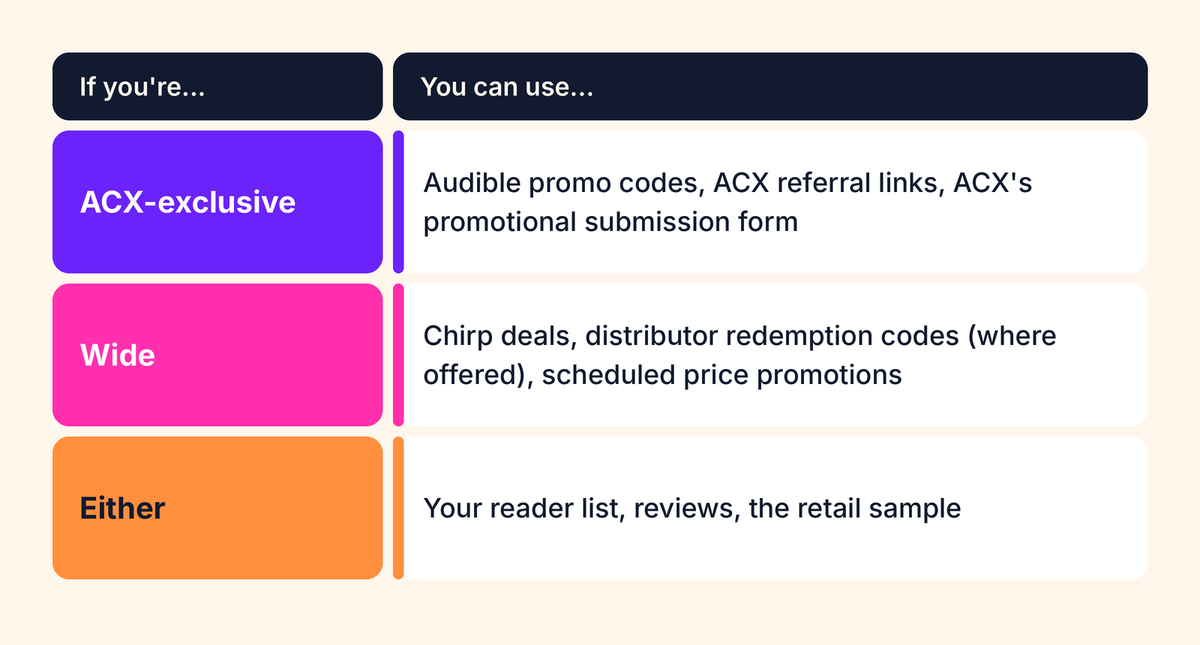
The rest of this guide follows that split. Skip to your section, then read “your reader list” and “reviews,” which apply to everyone.
If you’re ACX-exclusive, use promo codes well.
Promo codes let a listener download your audiobook for free on Audible. ACX makes them available only to rights holders of exclusive titles, and to producers working under Royalty Share.
How many codes do you get? You receive 25 codes per marketplace when your audiobook is published. Codes work in the US and UK only. After 10 redemptions and 100 qualified sales, you can generate 25 more. The maximum is 50 codes per marketplace, per title.
You may see older guides that say “up to 100 codes.” That limit is out of date, so use 50.
Do codes earn royalties? No. For titles published on or after March 26, 2020, ACX doesn’t pay royalties on promo code redemptions. Think of codes as marketing, not income.
Who should get them? ACX suggests sharing codes with reviewers, readers, your marketing team, and social followers. That includes newsletter giveaways and offering a code “in exchange for an honest review.”
The key word is honest. Ask for a review, never a positive one.
What happens to reviews from code listeners? They show the label “Listener received this title free.” That’s normal. It’s there for transparency under FTC review rules, and you don’t need to worry about it.
What else does ACX offer? Two more things. ACX provides referral links called Bounty links for Audible in the US, UK, France, and Germany. It also has a submission survey where you can ask to be considered for promotion. Check ACX’s promotional pages for how both currently work.
If you’re wide: Chirp deals
Chirp is a deal-focused audiobook store run by BookBub. It’s open to listeners in the US and Canada only, so it’s most useful if your audience is there.
How do you get listed? Authors list on Chirp through INaudio or Author’s Republic. Once your audiobook is for sale on Chirp, you submit it for a deal through the BookBub Partner Dashboard. BookBub’s Chirp submission guide walks through the steps.
What do the editors look for? A team of editors reviews submissions. They weigh three things:
- Content and platform: reviews, awards, and blurbs.
- Audio quality: they listen to samples and look for audio-specific reviews.
- Narrator reputation.
That second point is worth noting. A good book isn’t enough. The audio itself gets judged.
Timing and cost. You can schedule a deal up to two months ahead, and you should hear back within two weeks. Most deals run for about a month, priced between $0.99 and $5.99.
There’s no fee to be included in Chirp’s emails. Featured deals carry an extra 10% royalty fee, charged only for the length of the deal. Some guides online still say Chirp is free, so factor that fee into your plan.
A deal is a tool, not a guarantee. Treat it as one way to get your audiobook in front of new listeners, and decide whether it fits your book before you submit.
If you’re wide: redemption codes and scheduled promotions
Wide authors have two other tools, though what’s available changes, so check your dashboard first.
Distributor redemption codes. Some distributors have offered codes that let listeners redeem a free copy, for example on Spotify. An older help page described up to 100 codes per title, with no royalties on free copies. That page predates the rebrand to Voices by INaudio, so don’t rely on those numbers. Open your dashboard and see whether codes are offered, and what the current limit and process are.
Scheduled promotions. INaudio has a promotional pricing tool that lets you set a percentage discount for Apple, Barnes & Noble, Chirp, and Spotify. A few rules apply:
- Schedule it at least 3 days ahead, and no more than 6 months ahead.
- A promotion can run for 1 to 31 days.
- Once you submit, you can’t change it.
Because you can’t edit it after submitting, double-check the dates and discount before you hit send.
For everyone: your reader list is your best channel
Whichever setup you chose, the people most likely to listen are the ones who already read you. They know your voice, they like your stories, and they don’t need convincing that you’re worth their time.
So tell them. Announce the audiobook in your newsletter. Share the retail sample so they can hear a few minutes before deciding. Invite them to review it once they’ve listened.
It also helps to remember that listeners find audiobooks in many places. In the APA’s 2026 US consumer survey, past-year listeners got audiobooks by buying from websites or apps (49%), through subscriptions (48%), and by borrowing from libraries (46%). People could pick more than one answer, so these overlap, and “websites or apps” includes retailer apps. The point isn’t that any one route wins. It’s that listeners are spread across many places, so reaching your readers directly matters.
If you own your audiobook files, you can also deliver them straight to your own readers. Audibound Converter produces DRM-free, chapterized audiobook files that belong to you, so the relationship with your readers stays yours.
Reviews: the quiet engine
Reviews do two jobs. They help new listeners decide, and for wide authors they feed into Chirp’s editors, who look for audio-specific reviews.
That means it’s worth asking listeners to review the audio edition, not just the book. A review that mentions the narration, the pacing, or how the story sounds is more useful than one that only praises the plot.
Two simple rules keep this honest:
- Ask for honest reviews. Don’t trade codes for positive ones.
- Make it easy. A short note in your newsletter with a direct link works better than a general request.
A simple 30-day plan
Here’s a plan you can adapt. Skip anything that doesn’t fit your setup.
Week 1: Start with your readers.
- Announce the audiobook to your newsletter, with the retail sample
- ACX-exclusive: request your codes and send them to your first reviewers
- Wide: check your dashboard for redemption codes and current limits
Weeks 2–3: Reach out for reviews.
- Send codes or copies to reviewers, your street team, and newsletter volunteers
- Ask for honest reviews of the audio edition
- Share the retail sample again, on a different day and channel
Week 4: Plan your promotion.
- Wide: submit your Chirp deal, or schedule a promotion in your distributor’s dashboard
- Timing note: Chirp can take up to two weeks to reply, so submit earlier if you want a deal to land in this window, and INaudio needs at least 3 days’ notice
- Look at what worked, and keep doing it
The takeaway
Marketing an audiobook is marketing your story in a new format. The tools differ depending on how you published, but the starting point is the same: the readers you already have.
Begin there. Tell them it’s out, let them hear it, and invite them to share what they think.
References: