Checking narration…
On this page
You may have seen the offer. Spotify, Amazon, and Google will all turn your ebook into an audiobook, quickly and with little effort. That’s genuinely new, and it opens audio to authors who’d otherwise never get there.
Each one also comes with conditions most authors never read. Before you click “create,” here’s what you’re agreeing to.
What does “store-made” mean?
You give the store your ebook (an EPUB file), and it narrates the book with its own digital voices, inside its own system.
That’s different from making your own audio files and uploading them. When the store makes the audiobook, the store’s system and the store’s rules come with it. Those rules are what this guide is about.
What does Spotify’s tool actually do?
Spotify’s Audiobook Creation Tools turn an EPUB into an audiobook narrated by an ElevenLabs digital voice. Once processing finishes, your audiobook is published to Spotify, usually within 72 hours.
What it does well:
- It’s non-exclusive. Spotify for Authors is non-exclusive, and Spotify says the audiobook is yours. Wider distribution is available through its Voices by INaudio integration.
- You get some control. You can review pronunciations and listen to chapter previews before the final audiobook is created.
- It’s free for up to five projects per account.
The conditions to know:
- US self-published authors, English only.
- Five projects per account. Slots are permanent, so deleting a draft or unpublishing doesn’t free one up.
- Four generations per book. A generation is used each time your audiobook is generated or regenerated, including during editing and after publishing.
- 150,000 words maximum per manuscript.
- A label. Titles carry a “Narrated by Digital Voice” label on Spotify.
What does Amazon’s Virtual Voice do, and what’s the catch?
KDP’s Virtual Voice creates computer-generated narration of your Kindle ebook. It’s a US beta for KDP authors, available by invitation or through an interest list. You can set a different voice for each chapter, and the audiobook is sold wherever Audible audiobooks are sold, clearly labeled as virtual voice.
The condition that matters most is KDP Select. If your ebook is enrolled in KDP Select, the Virtual Voice audiobook is enrolled too, and it must be exclusive to Audible during that period. If you unpublish it, the exclusivity still runs to the end of the current 90-day term.
KDP Select titles are also included in Audible Plus. Amazon’s beta terms say that during the 90-day exclusivity period you can’t sell or distribute your book in audio format elsewhere.
So Virtual Voice can be a straightforward route for authors already in KDP Select. It’s a harder fit if you want your audiobook on several stores.
What does Google Play’s auto-narrated option offer?
Google Play Books converts an EPUB you already sell on Google Play into an audiobook. You need audio rights.
What it does well:
- Wide language reach. It supports English, French, German, Hindi, Italian, Portuguese (Brazil), and Spanish.
- Wide country reach. Publishers in 23 countries can use it, and you can sell wherever you hold rights.
- It comes with an editor for text and sound adjustments.
- It’s free during the beta. There’s no program fee.
You can also download the files and sell them elsewhere. The condition is that the title must also be on Google Play in every country where it’s sold elsewhere, at a price no higher than on other stores.
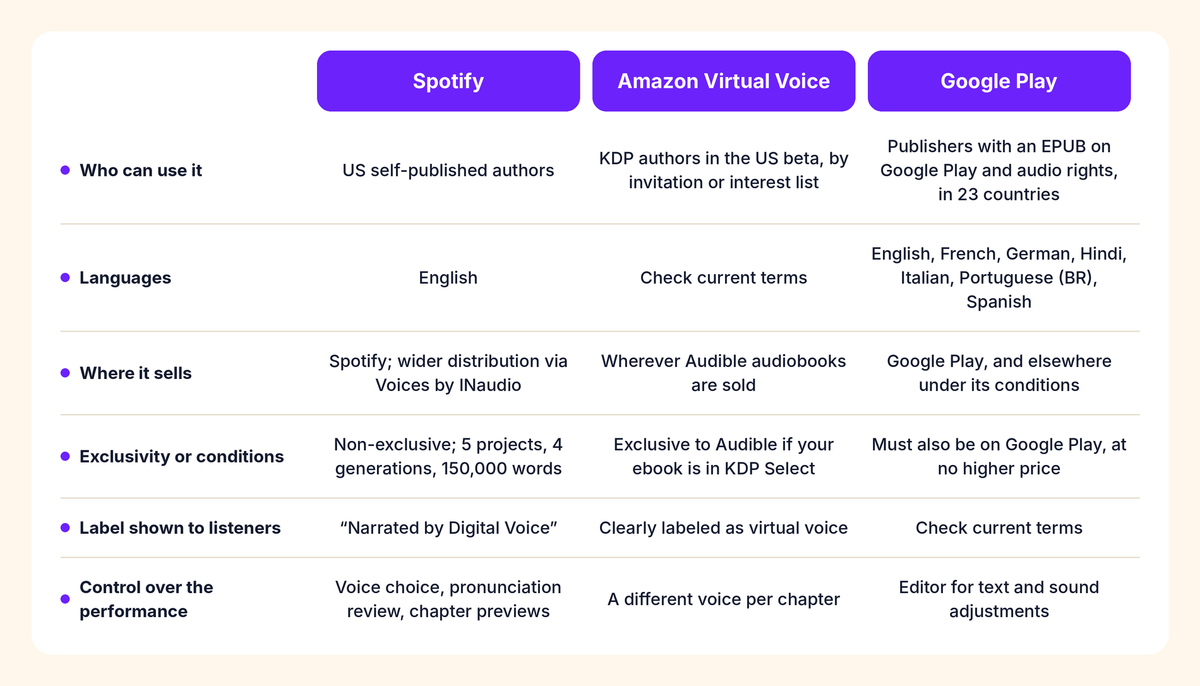
How do the three compare side by side?
What do you give up with a store-made audiobook?
Some threads run through all three.
Your say in the performance. You pick a voice and fix pronunciations, but you’re not directing a performance. There’s no cast, and no one shaping how a scene should feel.
Flexibility. Virtual Voice with KDP Select means Audible exclusivity. Google asks for matching prices and a Google Play listing. Spotify is the most open of the three, with its own limits.
Reach. Some channels may not accept store-made or labeled digital-voice titles. Check each platform’s rules before you assume a title can go everywhere.
Room to experiment. Spotify caps projects and generations, and Virtual Voice is invitation-only. Those limits mean you can’t endlessly redo it.
None of this makes these tools a bad choice. They’re trade-offs, and different books can accept different ones.
When does a store-made edition make sense?
There are legitimate reasons to use one:
- Testing demand. If you’re not sure a backlist title has listeners, a store-made edition is a low-effort way to find out.
- Nonfiction where clear delivery matters more than performance. A how-to or reference book doesn’t always need a cast.
- A book that would otherwise never be in audio. An audiobook that exists is better, for some readers, than one that doesn’t.
When might you want more control?
Other books ask for more:
- Fiction with many characters. Distinct voices help listeners tell characters apart.
- A series where voices must stay consistent. A single digital voice can’t give each recurring character a signature sound.
- A story you want performed rather than read. Tone, pacing, and mood carry a lot in fiction.